
New Book Announcement: Anastas Mikoyan

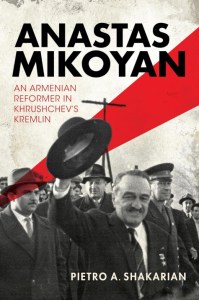
Book cover for "Anastas Mikoyan: An Armenian Reformer in Khrushchev's Kremlin"

Book cover for Anastas Mikoyan: An Armenian Reformer in Khrushchev’s Kremlin

The Reconsidering Russia blog and podcast have been on “hiatus” for a period of about five years. The last major activity was my interview with the late great historian Stephen F. Cohen, my friend and mentor best known for his biography of Nikolai Bukharin. Since then, a lot has happened. I completed my PhD at Ohio State, moved on to a lectureship in Yerevan, and then a postdoctoral fellowship in St. Petersburg. Over that time, the world witnessed major upheavals, including the still-ongoing war in Ukraine. All the while, I was steadily and meticulously preparing my monograph on Anastas Mikoyan and his reforms in the sphere of Soviet nationality policy during the period of Nikita Khrushchev’s Thaw.

Now, I am happy to report that my Mikoyan research journey is finally nearing completion. My forthcoming book Anastas Mikoyan: An Armenian Reformer in Khrushchev’s Kremlin will be published by Indiana University Press in August 2025, and it is already listed on Amazon.com. The study is largely based on never-before-seen materials from the Russian and Armenian archives, as well as memoirs in the Russian and Armenian languages. Here is Indiana’s official description of the book:

Veteran Soviet statesman and longtime Politburo member Anastas Ivanovich Mikoyan is perhaps best remembered in both the West and the post-Soviet space as a master political survivor who weathered every Soviet leader from Lenin to Brezhnev. Less well known is the pivotal role that Mikoyan played in dismantling and rejecting the Stalinist legacy and guiding Khrushchev’s nationality policy toward greater decentralization and cultural expression for nationalities.

Based on new discoveries from the Russian and Armenian archives, Anastas Mikoyan is the first major biographical study in English of a key figure in Soviet politics. The book focuses on the Armenian statesman’s role as a reformer during the Thaw of 1953–1964, when Stalin’s death and Khrushchev’s ascension opened the door to greater pluralism and democratization in the Soviet Union. Mikoyan had been a loyal Stalinist, but his background as a native Armenian guided his Thaw-era reform initiatives on nationality policy and de-Stalinization. The statesman advocated a dynamic approach to governance, rejecting national nihilism and embracing a multitude of ethnicities under the aegis of “socialist democracy,” using Armenia as his exemplar. While the Soviet government adopted most of Mikoyan’s recommendations, Khrushchev’s ouster in 1964 ended the prospects for political change and led to Mikoyan’s own resignation the following year. Nevertheless, Mikoyan remained a prominent public figure until his death in 1978.

Following a storied statesman through his personal and professional connections within and beyond the Soviet state, Anastas Mikoyan offers important insights into nation-building, the politics of difference, and the lingering possibilities of political reform in the USSR.

Here are some preliminary reviews:

“Shakarian’s study reflects a significant amount of scientific work. Especially noteworthy is his ability to analyze historical events and personae in a context that was constantly changing throughout the lifetime of Anastas Mikoyan. His work with sources is particularly impressive.”
~Mark Grigorian, author of Yerevan: Biography of a City

“This splendid piece of research and writing deals with important issues that have not been adequately explored before in historical scholarship. The archival revelations are stunning, and Shakarian brings new light to obscured topics, showing the inner workings of the Soviet system under Stalin and Khrushchev. Well-organized, readable, and never verbose, it is a much-needed and original contribution to the field of Soviet studies.”
~Ronald Grigor Suny, author of Stalin: Passage to Revolution

“Pietro Shakarian’s remarkable, comprehensive examination of one of the great, emblematic figures of the Soviet past stands as an invaluable contribution to the study of the role of the individual in history.”
~Edward Nalbandian, former foreign minister of Armenia

“This book is unquestionably an important contribution to scholarship on Soviet policymaking and nationality policy. Mikoyan has until now been an unjustly neglected figure in Soviet policymaking. By focusing on his personal networks and groundbreaking initiatives in the field of de-Stalinization, Shakarian has made an important and invaluable contribution to greater understanding not only of the Khrushchev period, but of Soviet history as a whole.”
~Alex Marshall, author of The Caucasus Under Soviet Rule

“Shakarian’s painstaking research produces new and comprehensive insights into Mikoyan’s deft and consequential role in the reforms that came to define Nikita Khrushchev’s post-Stalin Thaw.”
~Edward P. Djerejian, former US Ambassador

“Anastas Mikoyan stands as a central yet understudied figure in Soviet politics. A faithful member of Stalin’s Politburo, Mikoyan ultimately rejected Stalinism in favor of political liberalization under Khrushchev. In this outstanding biographical study, Pietro Shakarian employs pathbreaking archival research to uncover Mikoyan’s leading role in Khrushchev’s reforms. He demonstrates that Mikoyan drew on his Armenian heritage to reorient Soviet nationality policy during de-Stalinization. This book will be essential reading for scholars of Soviet nationality policy, Khrushchev’s Thaw, and the history of the USSR more generally.”
~David L. Hoffmann, author of The Stalinist Era

Finally, here is a rare documentary (in Armenian) of Mikoyan’s visit to Armenia in March 1962, courtesy of the National Archives of Armenia in Yerevan:

Reconsidering Russia Podcast: An Interview with Stephen F. Cohen

The Reconsidering Russia podcast has returned for a seventeenth installment featuring Dr. Stephen F. Cohen, Professor Emeritus of Russian History at New York University and Princeton University.

He is the author of numerous books on Russia and the former Soviet region, including the influential Bukharin and the Bolshevik Revolution and, most recently, War with Russia? on the current state of US-Russian relations. He is also the founder of the revived American Committee for East-West Accord.

In this interview, Professor Cohen reflects on US-Russian relations, his interest in Russian history, his friendships with Robert C. Tucker, Mikhail Gorbachev, and Anna Larina, his meeting with Svetlana Alliluyeva, and his (and his wife, Katrina vanden Heuvel‘s) long-time association with the Russian newspaper Novaya Gazeta.

Since I began my podcast in April 2015 at the University of Michigan, I have interviewed a diverse array of experts from Sergey Markedonov to Ellendea Proffer Teasley to Jack Matlock. Unfortunately, due to an increased workload over the next few years, I will no longer be updating this podcast on a regular basis. However, I thank both my guests and my listeners for many incredible experiences.

On hiatus

Several followers of this blog have inquired in recent months about future episodes of the Reconsidering Russia podcast. Unfortunately, due to an exceptionally high work load this semester at Ohio State and an upcoming research trip in Yerevan this summer, I will be taking an extensive hiatus from my podcast and blog until August 2018. Upon my return, I promise more insightful interviews on Russia and Eurasia. Until then, please stay tuned! До свидания!

Reconsidering Russia Podcast: An Interview with Ronald Grigor Suny

The sixteenth installment of the Reconsidering Russia podcast series features Dr. Ronald Grigor Suny, William H. Sewell Jr. Distinguished University Professor of History at the University of Michigan at Ann Arbor.

He is the author of numerous books on Russia, Armenia, Georgia and the former Soviet region, including The Baku Commune, The Making of the Georgian Nation, Looking Toward Ararat, The Soviet Experiment, and the forthcoming Red Flag Unfurled, to name a few. He was also the MA advisor for the host of this podcast at the University of Michigan.

In this interview, Dr. Suny discusses the history of his grandfather – the composer Grikor Suni – and his experience of the Russian Revolution, the Revolution in Transcaucasia, Stepan Shahumyan and the Baku Commune, and the issue of class and nationality in the Russian Revolution. This interview also includes discussions of Dr. Suny’s work with Leopold Haimson at Columbia, his close friendship with Moshe Lewin, Revisionism vs. Authoritarianism in Soviet and Russian historiography, and the recent push for “de-communization” in Armenia.

Reconsidering Russia Podcast: An Interview with Jack F. Matlock, Jr.

The fifteenth installment of the Reconsidering Russia podcast series features celebrated American Ambassador Jack F. Matlock, Jr.

In this wide-ranging interview, Ambassador Matlock discusses his life and career. It encompasses discussions of his interest in Russia, his first meeting with his wife Rebecca, his first assignment in Moscow in 1961, his diplomatic work in Africa, his time as Director of Soviet Affairs in the State Department in the 1970s, his work for Presidents Reagan and Bush, Sr. as the American ambassador to the Soviet Union from 1987 to 1991, and his first impressions of, and meetings with, Soviet President Mikhail Gorbachev. Ambassador Matlock also reflects on the folly of NATO expansion and an interventionist American foreign policy.

In addition to Ambassador Matlock’s illustrious diplomatic career, he also holds a PhD in Slavic languages and literatures from Columbia University. He is the author of three books: Autopsy of an Empire (1995), Reagan and Gorbachev (2004), and Superpower Illusions (2010).

Reconsidering Russia Podcast: An Interview with Alexander Rabinowitch

You say you want a revolution? The fourteenth installment of the Reconsidering Russia podcast series features Dr. Alexander Rabinowitch, Professor Emeritus of Russian History at Indiana University in Bloomington.

Dr. Rabinowitch is best known for his three-part book series chronicling the history of the October Revolution, particularly his classic work The Bolsheviks Come to Power: The Revolution of 1917 in Petrograd. He is currently writing a fourth volume entitled The Bolsheviks Survive: Government and Crises in Civil War Petrograd, including new research from previously little-used Petersburg historical archives.

This interview includes discussions with Dr. Rabinowitch on the history and historiography of the Russian Revolution, the forthcoming centenary, his Russian émigré family background, the role of the Russian émigrés in the formation of Russian Studies in the US. and his meetings with Aleksandr Kerensky, Vladimir Nabokov, Irakli Tsereteli, and Boris Nicolaevsky.

Reconsidering Russia Podcast: An Interview with Zhores Medvedev

The thirteenth installment of the Reconsidering Russia podcast series features prominent Russian biologist and writer Dr. Zhores Medvedev.

In this exhaustive interview, Dr. Medvedev discusses his life and career. It encompasses his scientific research, his youth in 1920s-1930s Leningrad, his father’s arrest during Stalin’s Terror in the 1930s, his military service in the Red Army during World War II, his dissent, and the dissent of his twin brother Roy Medvedev. He also recounts how he met his wife, Margarita, to whom he has been married for 66 years. In addition, this interview includes lengthy discussions of Dr. Medvedev’s relationship with his birthplace Georgia, his experience of Khrushchev’s Secret Speech, the Gorbachev years, contemporary Russia, and US-Russian relations today.

Reconsidering Russia Podcast: An Interview with Volodymyr Ishchenko

The twelfth installment of the Reconsidering Russia podcast series features Volodymyr Ishchenko, Senior Lecturer at the Sociology Department at the Kiev Polytechnic Institute in Kiev, Ukraine.

In this interview, Dr. Ishchenko discusses Ukrainian politics. Topics include the privatization in Ukraine in the 1990s, the Orange Revolution, the Maidan, Crimea, the rise of the far-right, the fortunes of the Ukrainian Communist Party, the state of the Ukrainian left in general, the state of the Ukrainian economy, and the prospects for socialist democracy in Ukraine, Russia, and the former USSR.

Dr. Ishchenko is also the Deputy Director at the Center for Social and Labor Research in Ukraine and an editor at the Commons Journal and the magazine September.

Reconsidering Russia Podcast: An Interview with Vladimir Pozner

The eleventh installment of the Reconsidering Russia podcast series features celebrated journalist Vladimir Pozner.

In this wide-ranging interview, Mr. Pozner discusses his life and career. It encompasses discussions of Mr. Pozner’s parents’ activities in the French Resistance in World War II, the Pozner family’s emigration to the USSR, the Khrushchev Thaw, the reaction of Soviet society to the Cuban Missile Crisis, Mikhail Gorbachev’s glasnost and perestroika, space bridges between American and Soviet societies, the Yeltsin years, the current state of US-Russian relations, and Russian society today.

This interview also includes lengthy discussions of Mr. Pozner’s prolific journalistic career of over 50 years, including his work presenting the “Soviet side” of the story on Ted Koppel’s Nightline and other programs, his partnership with Phil Donahue, his television career in contemporary Russia, and depictions of Russia in the American press today.

Reconsidering Russia Podcast: An Interview with Ellendea Proffer Teasley

The tenth installment of the Reconsidering Russia podcast series features Dr. Ellendea Proffer Teasley, author, translator, publisher of Russian literature, and co-founder of Ardis Publishers. She holds a PhD in Russian literature from Indiana University.

In this podcast, Dr. Proffer Teasley discusses her new book Brodsky Among Us (Academic Studies Press, 2017). The book was a bestseller in Russia and was just published in its original English language edition in April. She also discusses her late husband Carl Proffer, the founding of Ardis Publishers, the origin of the Ardis name, and her personal experiences with Russian literary giants Joseph Brodsky, Vladimir Nabokov, Nadezhda Mandelstam, Elena Bulgakova, and Lily Brik, among others.